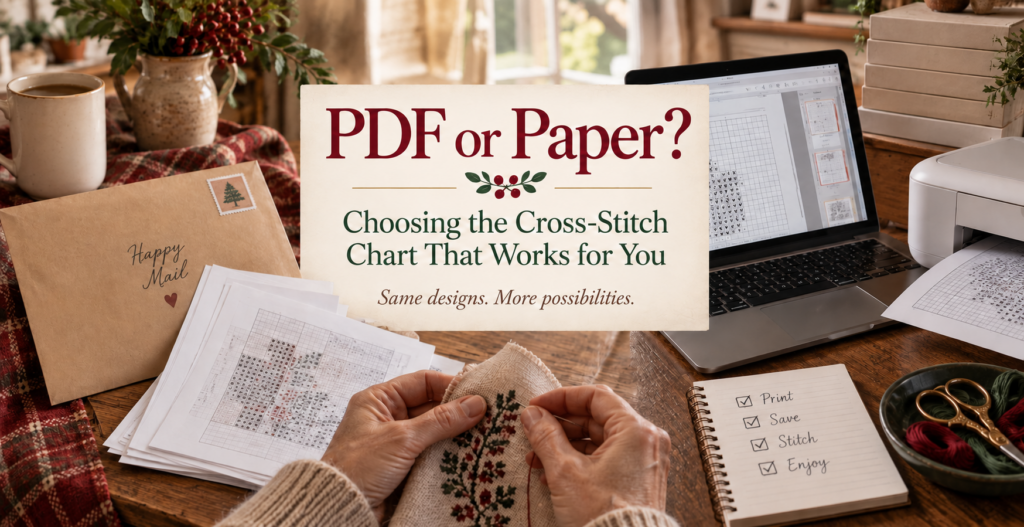
PDF or Paper? Choosing the Cross-Stitch Chart That Works for You
There was a time when buying a cross-stitch chart was pretty simple. You found a design you loved, ordered the chart, and a few days later an envelope arrived in your mailbox. For many of us, that is simply how cross-stitch charts have always been purchased.
But shipping has changed. Today, the postage required to get a relatively small paper chart from a needlework shop to your home can sometimes add $8 or more to your purchase. If you live outside the United States, the cost of shipping can make purchasing a single chart impractical altogether. That has made me think a lot about the way we buy our charts and whether we sometimes pay for paper and postage simply because that is what we have always done.
So I think it is worth asking a very simple question: Do I really need this chart to arrive in my mailbox, or do I just need the chart? There isn’t one right answer. Paper and PDF charts both have their place. But before spending nearly as much on shipping as you might spend on the chart itself, it may be worth thinking about how you actually use that chart once it arrives.
What Happens When the Paper Chart Arrives?
Think about your own stitching routine. The envelope arrives, you open your new chart, admire the cover photograph, study the design, gather your fabric and floss, and get ready to stitch. Then comes the part that is a little different for every stitcher.
Some of us sit down and stitch directly from the original paper chart. Others immediately make a working copy because we don’t want to mark up the original. Some enlarge the pages on a copier because larger symbols are easier to see. Many stitchers now scan or photograph their charts so they can work from a tablet or use whatever digital tools are part of their stitching routine.
When the project is finished, the original chart usually becomes part of our stitching library. It might be filed in a binder, tucked into a drawer or box, or stored with the rest of our patterns. There is absolutely nothing wrong with any of that. But when you stop and think about it, a PDF allows you to do many of those very same things without first paying to have several sheets of paper travel through the mail.
What Changes With a PDF?
Honestly, not nearly as much as you might think. You are still purchasing the designer’s chart. The real difference is simply how that chart gets from Anabella’s to you.
Instead of waiting for an envelope, your chart is delivered digitally. If you love stitching from paper, print it. If you prefer to keep a clean original and work from a copy, your original PDF remains safely stored while you print the pages you want to use. If larger symbols make stitching more comfortable, you can adjust your printing accordingly. If you prefer a digital stitching workflow, you already have the digital file available for your personal use with compatible software or apps.
You can still sit in your favorite chair, spread your floss around you, make a cup of coffee and stitch exactly the way you always have. The difference is that you didn’t have to pay $8 or more to get the chart from my shop to your mailbox, and you didn’t have to wait several days for it to arrive.
“The chart hasn’t changed. Only the way it gets from Anabella’s to your stitching chair has.”
What Could You Do With That $8 Instead?
This is the part that really made me start looking at digital charts differently. Eight dollars spent on postage gets your chart from my shop to your mailbox. Once that envelope arrives, that $8 has done its job.
Eight dollars saved on shipping, however, might become several skeins of floss. It might go toward the fabric for your project, a pretty finishing trim, or even your next chart. As someone who owns a needlework shop, I would much rather see more of your stitching budget go toward stitching than toward moving a few sheets of paper from my shop to your house.
But Sometimes Paper Really Is the Right Choice
I don’t want this to sound as though I think everyone should suddenly stop buying paper charts, because I don’t. There are plenty of good reasons to choose a professionally printed chart. Some stitchers don’t have a printer at home. Some don’t enjoy using computers or tablets with their needlework. Some find a professionally printed chart easier on their eyes, and others simply love the experience of receiving something tangible in the mail.
There are also stitchers who collect charts and enjoy organizing and keeping their physical pattern library. If that is part of the pleasure of cross stitch for you, then paper is probably worth the additional cost. Choosing paper because you genuinely prefer paper is very different, though, from automatically choosing it because you have never really considered the alternative.
And There Is Something Wonderful About No Waiting
You know that feeling when you see a design and immediately start thinking about the fabric in your stash that would be perfect for it? With a PDF, you don’t have to wait for a shipping notice, watch a tracking number, or wonder which day the mail carrier will bring it. Once your purchase is complete, you can have your chart and begin planning your project.
Digital charts also don’t occupy physical shelf space in a shop and don’t disappear simply because the last printed copy was sold. That makes it much easier for older designs to remain available and gives you a larger library of patterns to choose from whenever you’re ready for something new.
And Then There Is Our International Stitching Community
This may be one of the things I love most about being able to offer digital patterns. Anabella’s reaches stitchers far beyond our little corner of North Carolina. Unfortunately, international postage can turn a modest chart purchase into a very expensive order. Sometimes the shipping can cost as much as—or even more than—the item someone wanted to purchase in the first place.
A PDF removes that physical shipping barrier. There isn’t an envelope that has to cross the country or travel across an ocean. There is simply a stitcher somewhere who found an Anabella’s design she loves, purchased her chart, and can begin stitching it. I love the thought that where someone lives doesn’t have to determine whether an Anabella’s design is practical for her to enjoy.
So…PDF or Paper?
My answer is simple: choose the one that works best for the way you stitch. If receiving a professionally printed chart is part of the experience you love, choose paper and enjoy every bit of it. Paper isn’t going anywhere simply because digital patterns give us another option.
But if you’ve been choosing paper simply because that is how you’ve always purchased cross-stitch charts, perhaps the next time you see a design you love, give the PDF another look. Think about what you’re actually going to do with the chart when it arrives. If you’re going to make a working copy, enlarge it, put it onto a device, or simply stitch from those pages and then file them away, you may discover that digital delivery fits the way you stitch better than you realized.
Print it. Mark it. Enlarge it if you need to. Keep your original digital file safely stored for your personal use. Then take the money you didn’t spend on postage and put it toward a pretty piece of fabric, some new floss, or maybe even another chart. Because whether your pattern reaches you through your mailbox or your computer, the best part hasn’t changed at all: it’s what happens when you thread that first needle.
Happy Stitching,
Elayne
ANABELLA’S NEEDLEART
Where Every Stitch Tells a Story.
“`